
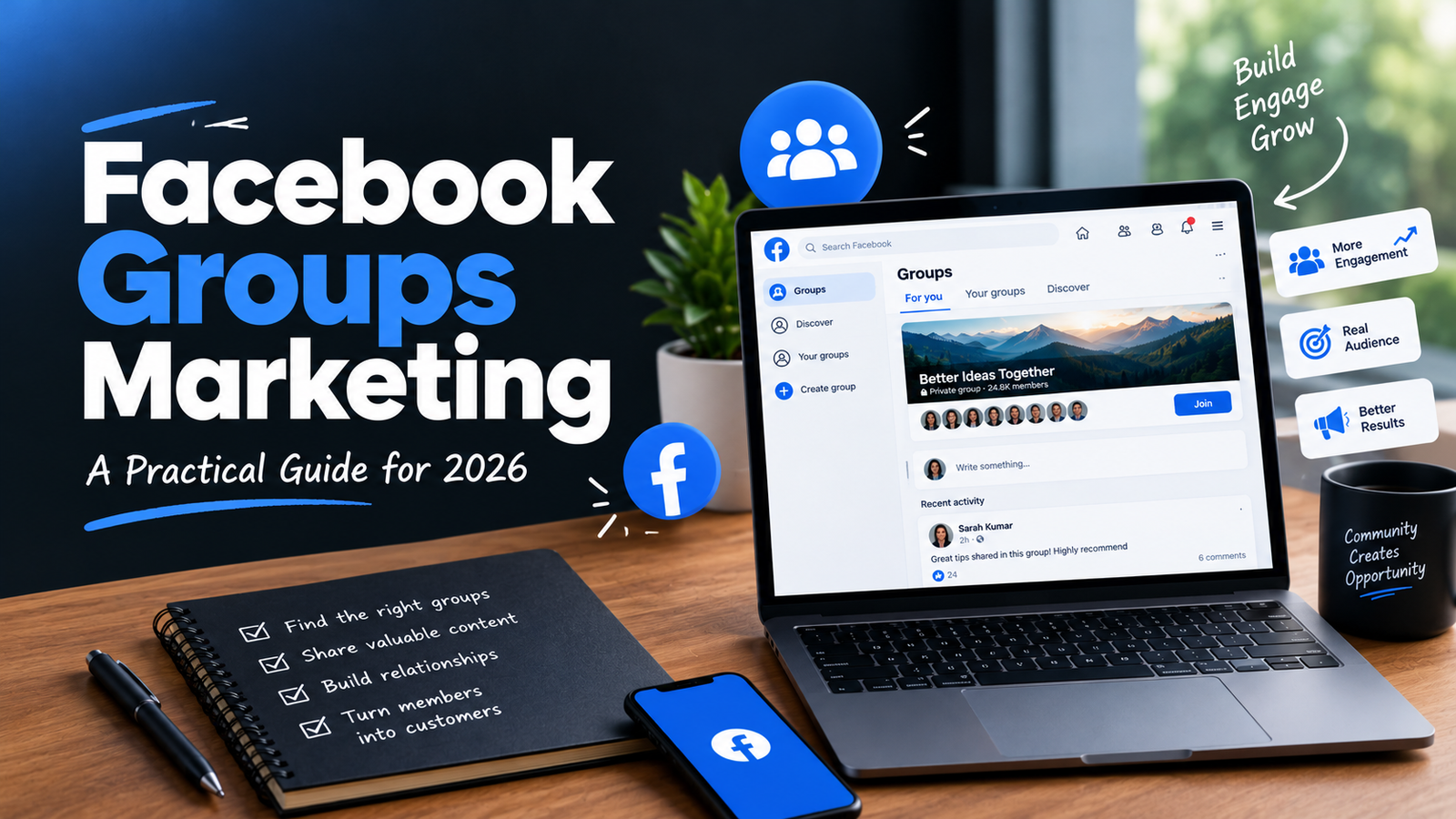
Facebook Groups marketing works because people choose to join Facebook Groups. Members ask questions, compare options, and seek advice from people they trust. This makes Facebook Groups a warmer audience than most cold ads ever reach.
Facebook Groups marketing can also move fast. Drop a link early. A moderator removes your Facebook Groups post. Do it again. Facebook Groups will label you as ‘that spammer.’ This guide shows how to market on Facebook Groups without annoying anyone. This guide teaches you how to pick Facebook Groups, build trust, follow rules, and measure results. This guide uses Meta’s community guidance and common methods. Treat this guide as a plan to test and adapt, not as a guarantee.
Why Facebook Groups Marketing Still Works in 2026
Meta publishes a Community for Brands guide. Meta says brands use communities for customer support, product innovation, loyalty, customer acquisition and retention. In other words Meta treats Facebook Groups as more than a place to post promotions.
Three things make groups valuable for marketers:
– Interest. Facebook Groups members join around a topic, so They already show what they care about.
– Two‑way conversation. Facebook Groups give questions and answers in minutes, not weeks.
– Trust. Facebook Groups members buy from voices they have seen helping others.
One caution, however. Meta controls how far posts travel in Facebook Groups. That can change. A Facebook Groups group is not an asset you own. Therefore use Facebook Groups marketing to start relationships and invite people onto an email list you control.
Join a Group. Start Your Own?
You can run Facebook Groups marketing in two ways. Most businesses should first join Facebook Groups, then build their group once Facebook Groups members’ needs are understood.
| Join existing groups | Start your own group | |
| Time to first results | Fast | Slow |
| Control over rules and content | Low | High |
| Ongoing effort | Daily helpful replies | Moderation, content, onboarding |
| Main risk | Removal for self-promotion | Empty group with no momentum |
| Best for | Testing messages, finding customers | Long-term community and loyalty |
How to Market on Facebook Groups: 8 Steps
1.Set one goal. Do you want leads, feedback or awareness? Pick one.
2.Find three to five Facebook Groups. Search your topic then check member count, activity and whether admins moderate. A smaller active Facebook Group beats an one.
3.Read the rules before you post. Many Facebook Groups ban links or promotion. Some allow them on days. Follow what is written.
4.Lead with help. Answer Facebook Groups’ questions fully with specifics. Skip the ‘DM me’ replies.
5.Polish your profile. People click your name. Make sure your photo, bio and featured link say what you do.
6.Share offers sparingly. When a Facebook Groups question truly matches your product, mention it once disclose your connection and let the Facebook Groups member decide.
7.Move conversations carefully. Offer a resource, such as a checklist, where the rules allow it. Never message Facebook Groups members who did not ask.
8 Review weekly. Note which replies earned reactions, questions or DMs. Then do more of that.
A hypothetical example
Imagine you run a bookkeeping service for freelancers. Instead of posting your prices, you answer a Facebook Groups member’s question about quarterly tax estimates in four clear steps. You mention nothing about your bookkeeping service.
Two days later someone replies, ‘Do you help with this?’ Now the conversation is invited. That is the pattern to aim for.
Facebook Group Marketing Strategy, for Your Own Group
Starting a Facebook Group is a commitment. A simple Facebook Groups marketing strategy keeps it manageable.
Promise something
screening questions
Post on a rhythm
Try video and live sessions.
Share the workload
Common Facebook Groups Marketing Mistakes
Most Facebook Groups marketing failures stem from habits:
– Sending links in Facebook Groups every week.
– Leaving comments in every Facebook Group.
– Disregarding Facebook Groups’ rules.
– Using Facebook Groups as if they were ad space.
– Pursuing member interaction in Facebook Groups.
– Depending on Facebook Groups without an email list.
Here is how to measure Facebook Groups marketing results.
Attribution is not perfect here because most value happens inside Facebook Groups conversations. Still, signals can be tracked.
| Metric | What it tells you | Where to find it |
| Comments per post | Does content spark discussion | Group Insight (your group) |
| Member growth | Does interest grow | Group Insight |
| Conversation started manually | Does bullying interest appear | Messenger log you keep |
| Link clicks | Does traffic come from the group | UTM links in your analytics tool |
| Leads and sales | Does business impact increase | CRM.How did you hear about us |
Add that question to your forms. Self‑reported answers often reveal what analytics miss.
FAQs
– Is Facebook Groups marketing free?
Joining and starting Facebook Groups costs nothing. The real cost is time because trust takes participation.
– Can I post links in Facebook Groups?
It depends on each Facebook Group’s rules. Check them first. If links are banned, share value in the comment itself. Let people ask for more.
– Should I use a Facebook Page or a Group?
Often both are useful. A Page is required to run Meta ads. Facebook Groups cannot run ads. A Facebook Group is better for conversation and loyalty.
– How long does it take to see results?
It varies by niche and Facebook Group size. It depends on how you participate. Plan for weeks of effort, not days.
– Are Facebook Groups going away?
Meta has no announcement for retiring Facebook Groups for business use. Reach and features can still change, so build an email list as a backup.
Conclusion
Facebook Groups marketing rewards patience and generosity. As a Freelan
ce Digital Marketer in Kannur, I recommend focusing on building relationships rather than directly selling your services. Let trust do the lifting.
Here are your takeaways:
- Join three to five Facebook Groups and read every rule.
- Answer questions and provide valuable information before mentioning your offer.
- Disclose your connection whenever you recommend your product or service.
- Start your own Facebook Group only when you can consistently provide value.
- Track leads weekly to measure your progress.
- Move interested people to an email list that you own.
Take action today: Pick one Facebook Group and answer three questions. That’s how you start building trust, growing your network, and attracting potential clients.
Readability and honesty notes: The text uses paragraphs and simple words. It aims for a reading level that’s easy to understand. It makes no claims based on experience because you have not done the work yet. The example is marked as hypothetical. To improve credibility, add a real case study, screenshots or numbers after you try the steps, with a Facebook Group. Also add an author bio with your qualifications.